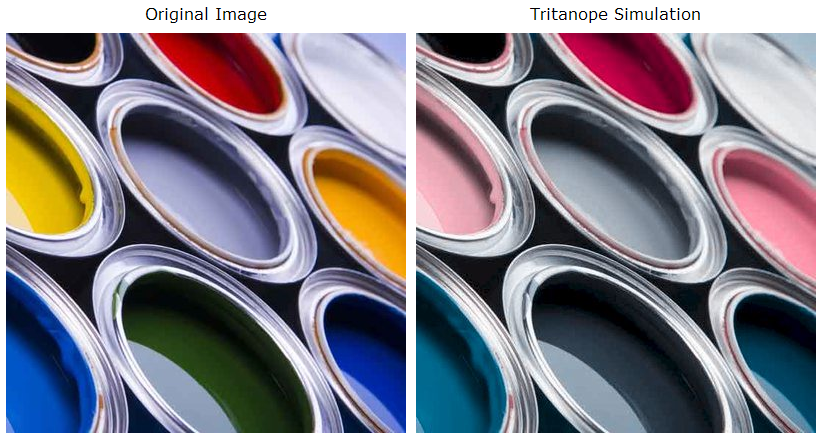
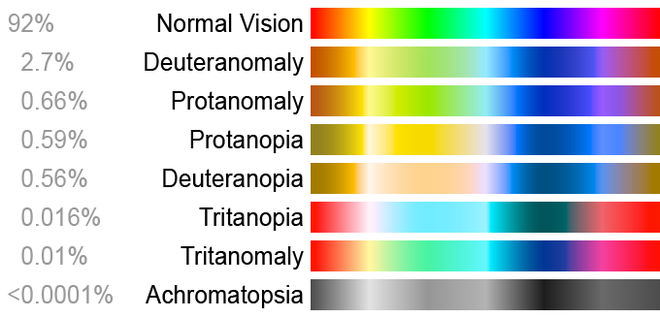
The different anomalous conditions are protanomaly which is a reduced sensitivity to red light deuteranomaly which is a reduced sensitivity to green light and is the most common form of colour blindness and tritanomaly which is a reduced sensitivity to blue light and is extremely rare.
Comparison blue yellow color blind.
National library of medicine blue yellow color blindness affects fewer than 1 in 10 000 people worldwide.
This particular form of color blindness also known as tritanopia is far less common than its red green counterpart.
Someone who is color blind is technically not blind to colors but may misidentify confuse fail to notice or notice colors less quickly than normal.
In fact according to the u s.
The cones that perceive blue are affected so blue shades appear greener than they really are and you may have difficulty distinguishing yellow and red from pink.
People who suffer from blue yellow color blindness have difficulty distinguishing between blue and yellow colors.
The effects of anomalous trichromatic vision can range from almost normal colour perception to almost.
There are 2 types of blue yellow color blindness.
Tritanomaly makes it hard to tell the difference between blue and green and between yellow and red.
Blue yellow color blindness is less common than red green color blindness though red green color blindness often accompanies it.
With this type of color blindness you have trouble differentiating.
Blue yellow color blindness is quite uncommon and the name itself taken as a description is actually quite misleading.
This less common type of color blindness makes it hard to tell the difference between blue and green and between yellow and red.
Your blue cone cells are abnormal so blue appears greener and it can be hard to distinguish yellow and pink.
Tritanopia makes you unable to tell the difference between blue and green purple and red and yellow and pink.
However unlike red and green color blindness blue yellow color blindness is not more prominent in males as the gene that causes the s cones to.
Blue yellow color blindness blue yellow color blindness doesn t occur as often as red green color blindness.
About 1 in 12 male and 1 in 200 females worldwide have congenital red green color vision deficiency cvd.
In other cases yellow shades may look purple or gray.
It is also sometimes called blue yellow color blindness.
Tritan color blindness most commonly acquired later in life due to aging of the eye or a medical condition such as glaucoma and is only very rarely inherited from birth.
People who are blue yellow color blind will confuse some shades of blue with green and some shades of yellow with violet.
Referred to as blue yellow color blindness.
Diagnosing blue yellow color blindness blue yellow color blind test blue yellow or blue green colorblindness is characterized by a loss of color discrimination capability for shades of blue and yellow which might be associated with age related factors genetic or inherited factors exposure to certain toxins such as mercury etc.